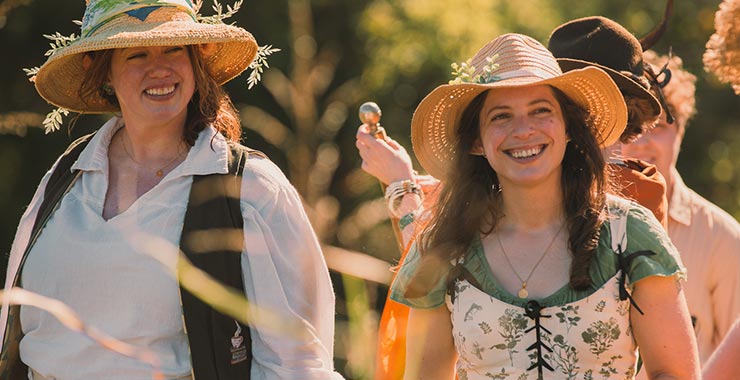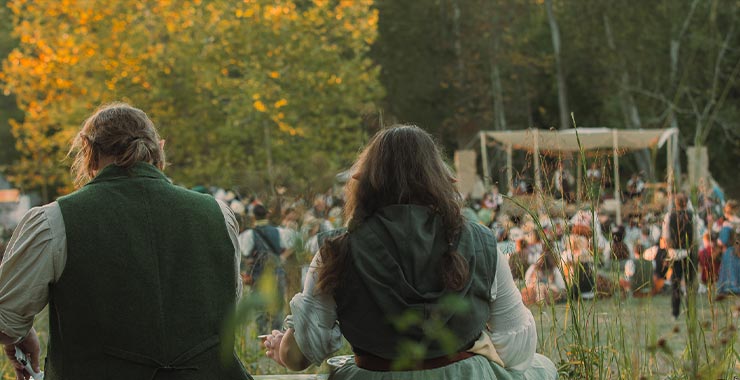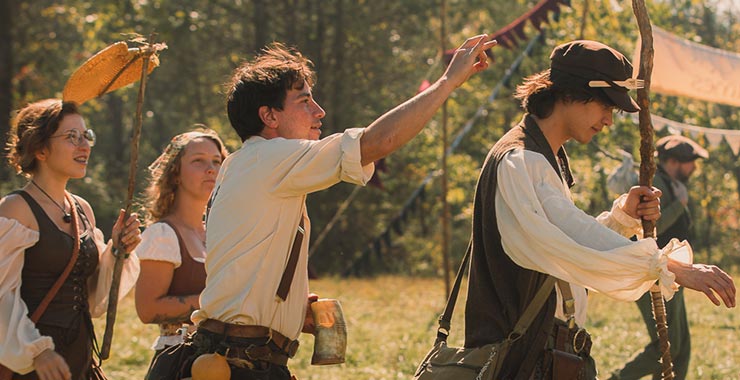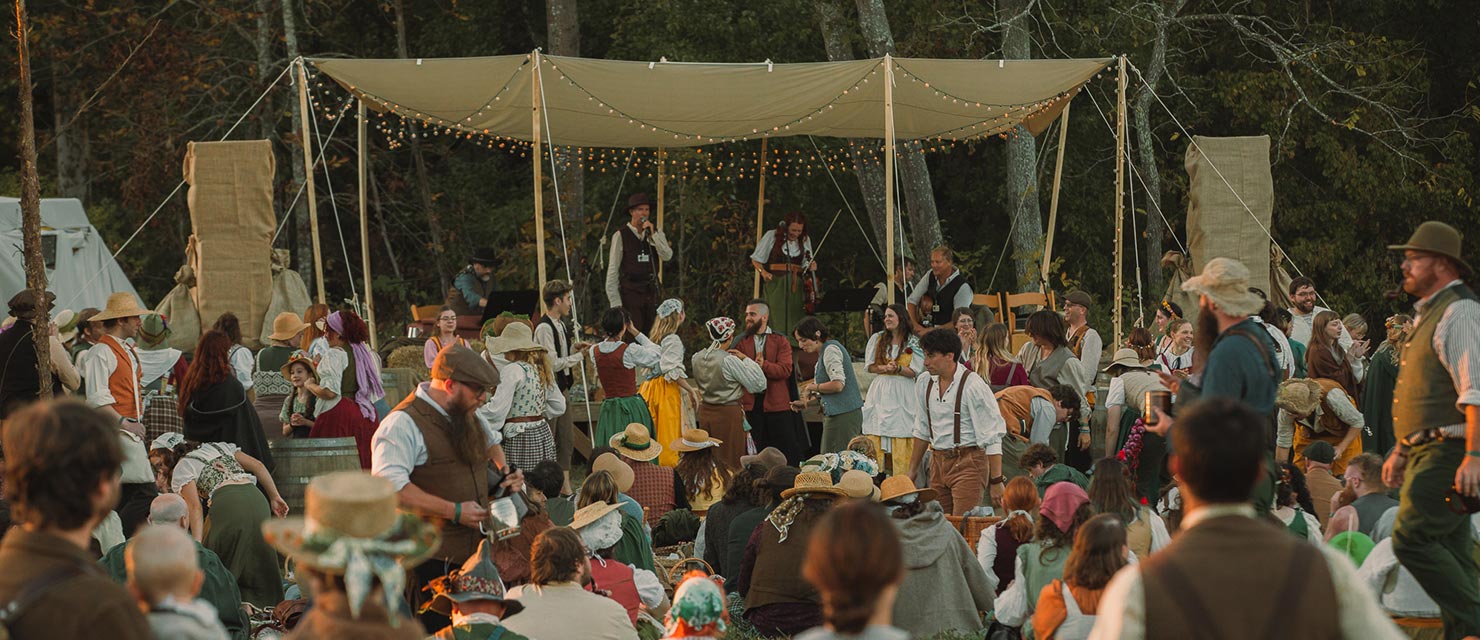
Before you commit to building a costume, packing a canvas tent, and spending a weekend as a Hobbit — it helps to know what a day at the Brandywine Festival actually looks and feels like from the inside. What follows is a portrait of a typical day at the event. Not a schedule — the Brandywine Festival doesn't work that way — but a texture. A sense of how the hours unfold when you're living as a Hobbit in the Shire.
Dawn: The World Comes to Life Slowly
The Shire does not wake with an alarm. It wakes with birdsong, the smell of woodsmoke, and the sound of canvas rustling as early risers begin to stir. The first light at the Brandywine Festival has a particular quality. Mist sometimes sits low over the field. Lanterns that were left burning overnight glow faintly in the grey. Here and there, a Hobbit emerges from their tent wrapped in a wool blanket, heading in the direction of the communal fire with a kettle in hand.
The early morning hours are among the quietest and most beautiful of the whole event. Conversations are soft and unhurried. There is no agenda. A cup of tea, shared with someone you met yesterday, is a perfectly sufficient way to begin the day.
First Breakfast: Because One Is Never Enough
Hobbits eat, famously and enthusiastically, multiple times a day — and the Brandywine Festival embraces this wholeheartedly. By mid-morning, the communal fire areas are busy with the sounds and smells of cooking. Cast iron pans. Kettles coming to the boil. The particular satisfaction of bread toasted over an open flame.
Food at the festival is a social activity as much as a practical one. Sharing what you've brought, accepting something offered by a neighbour, eating together around a fire — these small acts of hospitality are the texture of Hobbit life, and they happen constantly, naturally, throughout the day.
Mid-Morning: The Village Awakens
By mid-morning, the festival grounds are fully alive. Hobbit characters move between campsites, exchanging greetings in the particular warm cadence of Shire speech. A merchant has set up a small stall near the main path. A musician is already playing somewhere — the sound carrying pleasantly across the field.
This is the time for wandering. For exploring the village that has assembled itself over the past day or two. For noticing the details — the hand-painted sign above a neighbour's tent, the small garden of potted herbs arranged around a doorway, the carefully decorated interior visible through an open canvas flap.
It is also the time when the day's first stories begin to circulate. Whispered conversations. A letter delivered by one of the in-character messengers. A rumour — half confirmed, half speculation — that something unusual was seen near the edge of the forest last night.
Afternoon: The World Deepens
The afternoon hours are where the heart of the roleplay tends to happen. With the camp fully awake and the day well underway, characters begin to pursue their own stories.
Some attendees spend their afternoons in long, rambling conversations — the kind that drift from the price of pipeweed to the history of their family's farthing to a mild but dramatic disagreement about whose apple cake deserves the festival prize. Others follow the threads of whatever plot the event's writers have seeded — investigating the strange rumours, seeking out a particular character they've heard about, attending a scheduled gathering at the communal fire.
There is no pressure to be anywhere or do anything specific. The afternoon at the Brandywine Festival has the quality of a long, slow summer day — full of possibility, entirely unrushed.
Mealtimes: Time Is Fluid
One of the genuine pleasures of the Brandywine Festival is its relationship with mealtimes. Hobbits eat frequently, joyfully, and without apology — and the event's rhythm reflects this. The communal fires are rarely empty. Someone is always cooking, or eating, or offering something to a passer-by.
First-timers quickly discover that eating at the festival is less about sustenance and more about connection. Every meal is an opportunity to sit with someone, share what you have, and let the conversation take you wherever it wants to go.
Evening: The Magic Hour
If the mornings are quiet and the afternoons are rich, the evenings are something else entirely. As the light fades and the lanterns come on across the camping areas, the atmosphere shifts into something warmer and more intimate. Fires are tended. Music becomes more frequent, and people drift toward it naturally. The day's stories are told and retold, growing slightly with each telling in the best Hobbit tradition.
The Social Zone, in particular, comes alive at this hour. Impromptu gatherings form around fires. A bard moves from group to group, collecting requests and audience. Somewhere nearby, a group of Hobbits has produced instruments apparently from nowhere and is attempting a complicated folk song with varying success and great enthusiasm.
The evenings tend to run later than people expect. Not because anything dramatic happens — but because nobody particularly wants to leave.
Night: Lanterns and Stars
When the Quiet Zones fall silent and even the Social Zone settles into softer conversation, the festival has a particular late-night beauty. The lanterns are lower. The fires are embers. The stars, if the night is clear, are extraordinary.
This is often the time when the best conversations happen. The ones that aren't performances, and aren't part of any plot — just two people, in costume, sitting near a dying fire, talking about the things that matter to them. As themselves, or as their characters. Sometimes both at once.
The Next Morning: You Don't Want It to End
The last morning of the Brandywine Festival has a bittersweet quality that almost everyone remarks on. The world that took time to build has become, briefly, real — and returning to ordinary life feels slightly surreal. Most people leave with new friendships, a collection of small gifts and memories, and the quiet but persistent conviction that they will find a way to come back.
This is a day in the life of the Brandywine Festival. It is, on paper, a series of ordinary things: meals, conversations, music, fire. In practice, it is one of the more extraordinary things many attendees will do in a year.