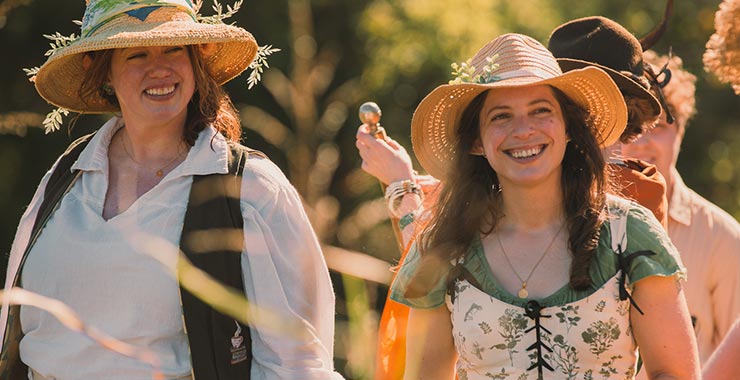
It's the question that sits at the heart of preparing for any live-action roleplay event, and it can feel surprisingly daunting. You've read about the Shire. You've started thinking about your costume. But the character — the actual person you're going to be for several days — still feels vague and uncertain.
Here's the reassuring truth: you need much less than you think to get started. A Hobbit character is not a complicated architecture of backstory and motivation. It is, at its core, a personality and a name. The rest fills in as you play.
Start With a Name
Hobbit names follow recognisable patterns, and getting yours right is one of the quickest ways to feel genuinely in the world.
Feminine first names tend toward flowers, plants, and soft sounds: Daisy, Peony, Amaranth, Primrose, Lily, Marigold. Masculine first names are often short and plain, with an old-fashioned English quality: Bungo, Odo, Folco, Hamson, Tolman, Robin. Family names carry geography and social standing: Took, Brandybuck, Goodbody, Hornblower, Proudfoot.
Your family name will prompt reactions from other players and give you an instant hook for conversation.
Sketch a Personality, Not a Biography
Resist the urge to write a lengthy backstory before the event. What you need instead is a sense of how your Hobbit moves through the world. A few questions worth sitting with:
What does your Hobbit do? Are they a farmer, a baker, a brewer, a gardener, a musician, a herbalist, a miller? Hobbits are agricultural people, and most of their occupations are rooted in the land or in practical craft. Your occupation will shape your conversations, your knowledge, and the kinds of gifts you might bring.
What does your Hobbit care about? Not in a grand sense — in a small one. A particularly fine harvest. The reputation of their family's garden. A recipe they've been perfecting. A grudge about a fence line. The small passions of Hobbit life are the fuel of Hobbit drama.
How does your Hobbit feel about the outside world? Most Hobbits are comfortable, settled, and not especially curious about what lies beyond the Shire. But some — particularly younger Hobbits, or those with a Took in the family tree — have a restlessness they'd never admit to. How does yours sit on that spectrum?
The Three Hobbit Qualities Worth Playing
Whatever your character's specifics, three qualities should underpin how you play them.
Warmth. Hobbits are hospitable by nature. They offer food, they remember names, they are genuinely pleased to see neighbours. Starting from a place of warmth will open more doors in a single afternoon than any amount of clever backstory.
Curiosity. Hobbits are famously nosy. They want to know what their neighbours are up to, what news has come from the next farthing, and whether that story about strange riders in Buckland is really true. Letting your character be genuinely curious will lead you naturally into conversations and stories.
Delight in small things. This is perhaps the most specifically Hobbit quality of all. A Hobbit who receives a gift, however small, is genuinely moved by it. A Hobbit who finds something unexpectedly beautiful — a well-kept campsite, a clever piece of handiwork, a particularly good cup of tea — will say so, with real feeling. Playing this quality requires only a small adjustment to normal social behaviour, but the effect on the atmosphere around you is disproportionate.
What You Don't Need to Know
You do not need to know every corner of Tolkien's lore. Your character, as a Hobbit who has likely never left the Shire, would not know it either.
What most Hobbits know: their local area, their family, the main stories passed around at the inn (the Battle of Greenfields, old Mad Baggins and his tales of trolls and dragons), and the gossip of their particular corner of the Shire.
What most Hobbits don't know: the detailed history of Middle-earth, the nature of the Rings of Power, anything much about Elves or the kingdoms of Men. If another player brings up something you've never heard of, your Hobbit's appropriate response is probably mild skepticism or polite bewilderment — which is perfectly correct.
A Small, Useful Ritual
Before the event, find a quiet fifteen minutes and sit with your character. Say their name out loud a few times. Think about what they ate for breakfast that morning, what they packed to bring to the festival, who they were looking forward to seeing, and what they hope the week will bring.
You don't need to write any of this down. You just need to let the character exist for a moment before you need to be them.
Then, when you arrive at the festival and put on the costume — let the character settle into your body. Walk a little slower. Notice things. Accept the cup of tea that someone offers you. Ask someone their name and where they're from. The character will find you. They always do.
"The character will find you. They always do."