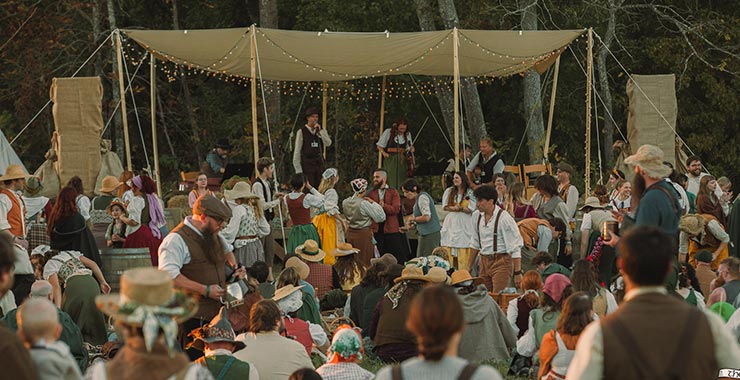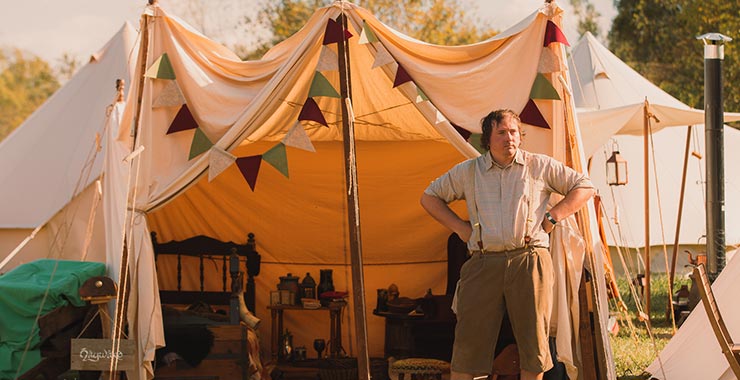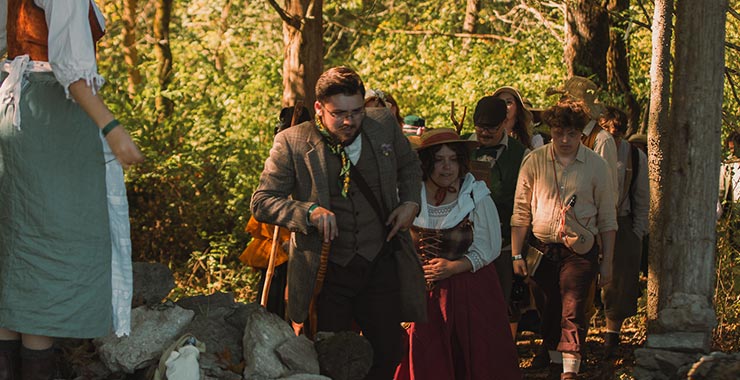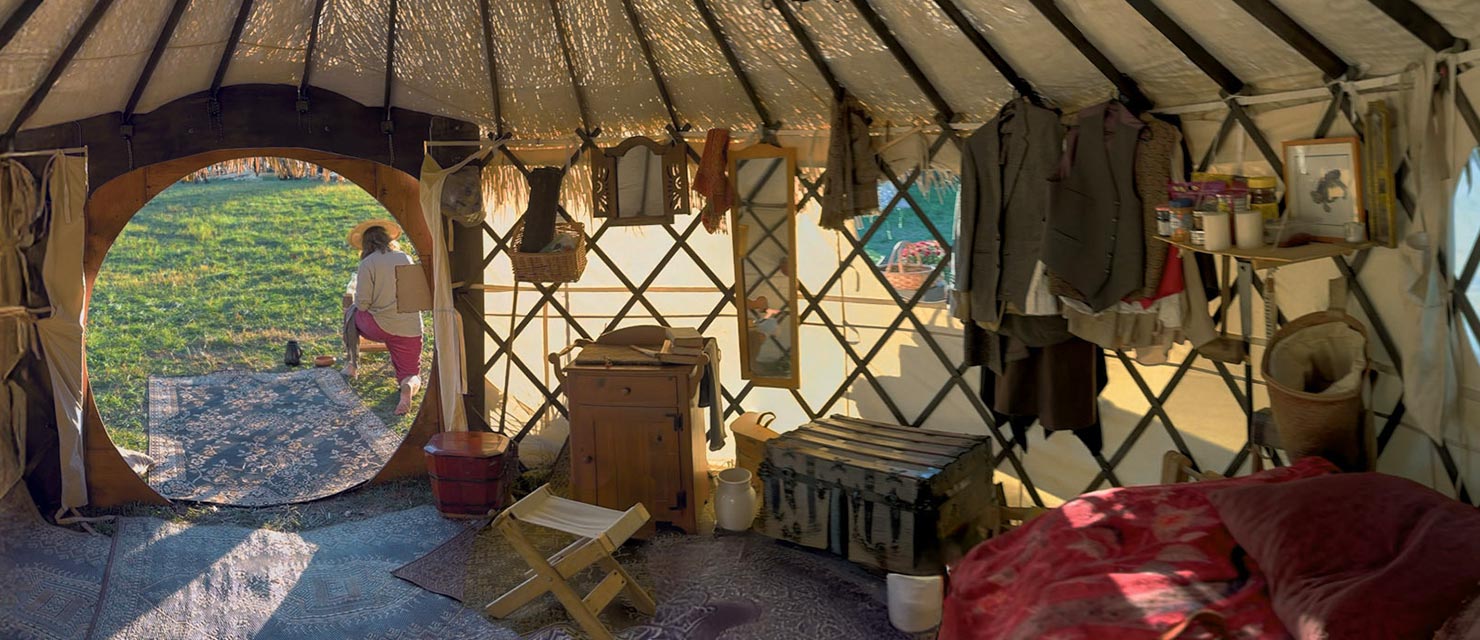
Some ideas wait years for the right moment to exist. For Gabriel De La Vega, the idea of a yurt with a round Hobbit door waited the better part of two decades — until an email from Kentucky finally gave it a home. The result is the ThatchTop Burrow: a handcrafted, thatch-roofed yurt that will sit among others like it in The Grove at the US Brandywine Festival. We sat down with Gabriel to talk yurts, lanterns, round doors, and the particular magic of a home you didn't know you'd always lived in.
Can you tell us a little about yourself, and how you got into this as a business?
My first time dipping my toe into live-action stuff was in college. They had a student organization day and one of them was the college chapter of a medieval reenactment organization: the Society for Creative Anachronism, or SCA. The SCA is a lot of people's introduction to dressing up in silly clothes and pretending you're someone you're not.
I went to my first Pennsic, which is their über event, and it's safe to say that changed my life. It just blew my head open in terms of occupying another world for a week or two. The common thread all these events share is: let's escape normality for a bit, go be somewhere else, do something else, be someone else. I became addicted to that early on.
The yurts came first. I was at my third Pennsic and I said, okay, this is clearly going to be part of my life for as long as I can make it. I endeavored to build a very basic 10x10 European pavilion — square sides, 2x4s from Home Depot. And I made it out of painter's cotton drop cloth from a hardware store, thinking "this is good enough, right?" That year was famously one of the wettest years ever recorded at Pennsic. My tent just shriveled into its component atoms.
So I took a walk to see how other people had solved the problem of shelter. I made almost a full loop into the woods and saw my first yurt, belonging to a gentleman I'm still pretty decent friends with. I walked in, and his children had bunk beds anchored to the wall to make sure they didn't fall. I went into that yurt and I'm like, this is it.
The lanterns came later. My mother gifted me a hand-blown Moroccan lantern. I put it up on the rafters. One of the best parts of a yurt is that the frame is sturdy enough to hang all sorts of things, and one evening at Pennsic, I saw the colored light just reflecting on the roof. There was a certain magic in that moment. These things complement each other very well.
A yurt roof is an inverse cone, so it's a perfect reflector. The canvas is a light color, so a lot of the light gets reflected back through, and some of it goes through and paints the canvas that color of light as it goes up. I'm still not over that, 20 years later.
Where did the idea for a Hobbit-style yurt come from, and how did it find its home with The Brandywine Festival?
I'm obviously a huge Tolkien nerd. My ingress into that lore was mostly the movies, which now I've lived long enough that the movies themselves are classics, and I can't believe that's right. I'm a very visually engaged person; I respond to aesthetics. Those films, every frame I was pausing to be like, "Oh my god, look at that prop, look at that saddle." So I've had the idea of "what if a yurt had a baby with a hobbit hole" for years. Those two things came together in my mind because as I was discovering the world of Tolkien and Middle-earth, I was also discovering yurts and starting to do variations on them.
Then I received an email from one of your folks, saying they were hosting a private LARP event in Kentucky and were interested in a certain number of yurts. We talked, sort of disappeared like ships in the night. Three months later, the Kickstarter dropped, and I heard back, "Now that it's up and running, I can reveal to you what this is," and I leaned forward in my chair.
Burgschneider ended up going a different direction with the main tent vendor, but they said, "Please come and be here as a vendor." And I said, "We're not just bringing the lantern shop. There has never been a better opportunity to bring this idea to life."
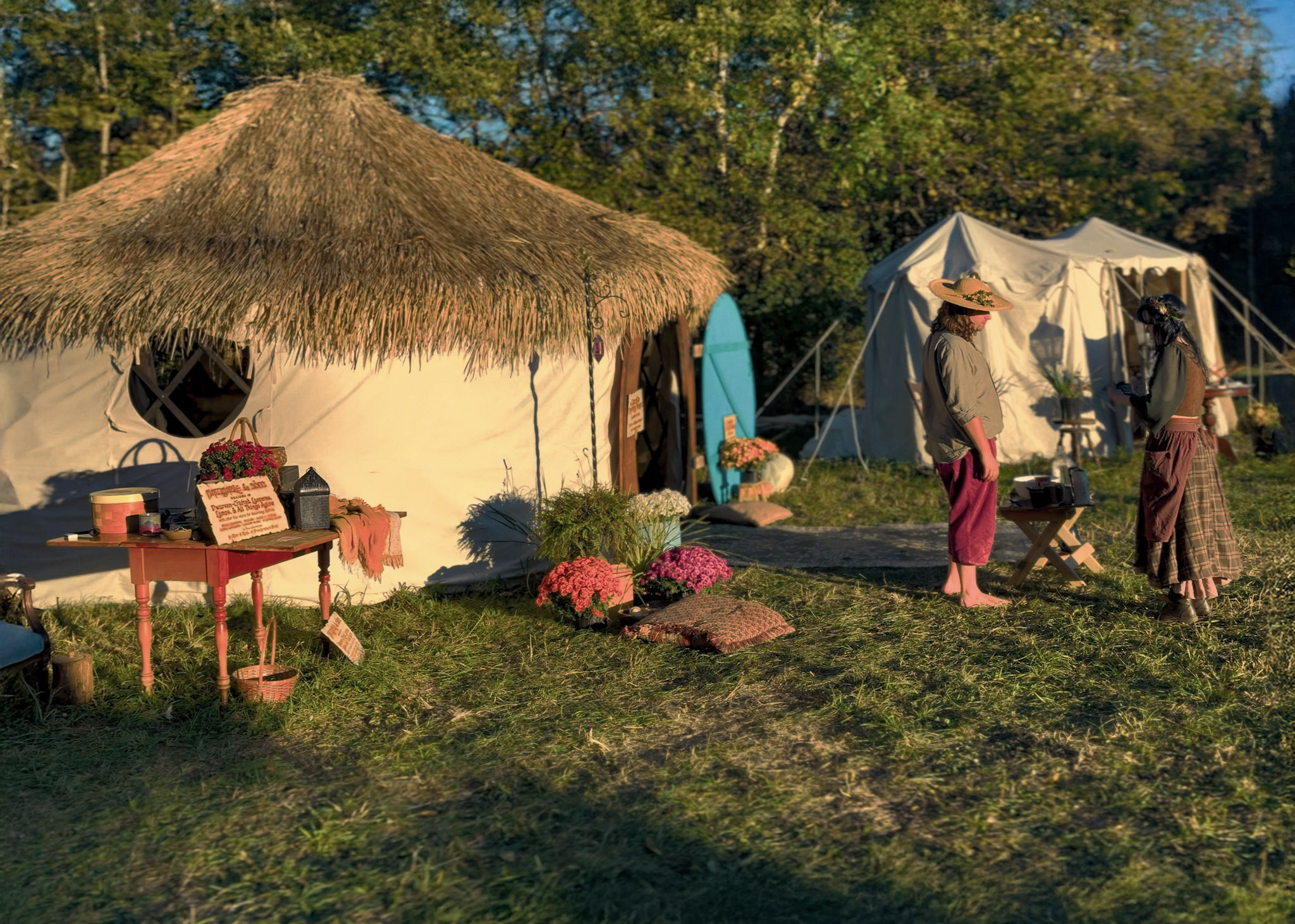
I gave my production director Chris the elevator pitch. I said, "I've always wanted to put a round door on a yurt, and there's this Brandywine Festival coming up." He's not at all a Middle-earth sort of person, but I showed him a couple of reference images. We're not the first people to want to build a hobbit burrow, so there's plenty of reference from others who've done it themselves. He came back the next day with a 1:16 scale mockup. It was double-hinged, opened this way and also that way. All I wanted was one note: fully round. A month later, it existed. From the time he presented me that mockup to the time my assistant R.J. and I were trundling down Kentucky roads was four weeks. I'm sitting in the prototype now, and it has far exceeded my expectations.
What makes the round door so essential to the whole vision?
The round door is the iconic image. When you imagine The Shire, it's always the door that comes to mind first.
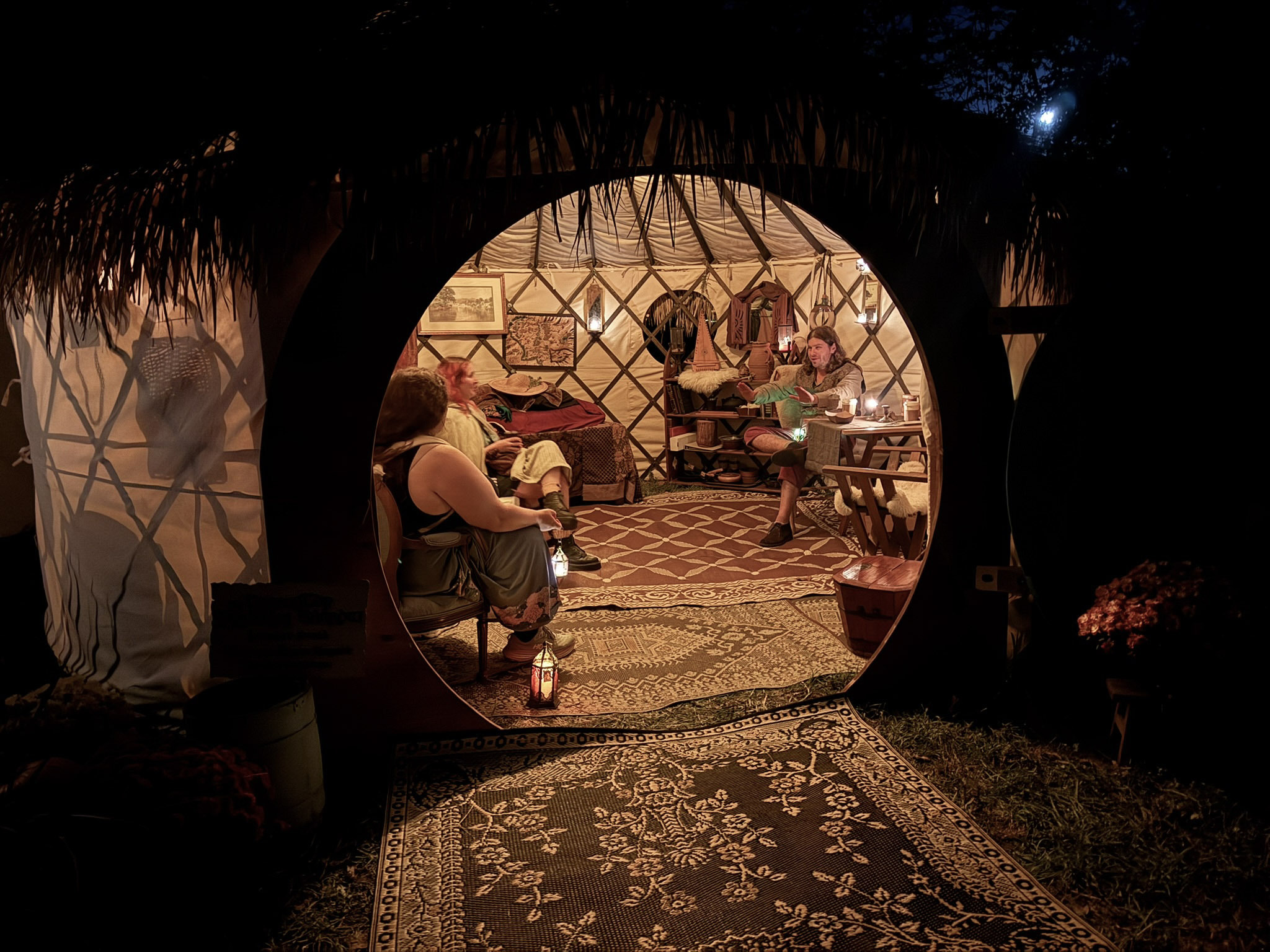
We taper it flat at the bottom; we didn't want anyone to have to step up into the burrow, especially thinking of guests who use walkers or canes. So it's fully round except for the bottom three feet where we cut it flat. Three feet is kind of the perfect width. You can be standing on one side and someone can very easily come in right next to you, no problem.
But when the door is fully open, it's just this big beautiful window into the world or into the burrow. It's very inviting either way.
And the double hinge gives you a whole language of hospitality. Cracked open is "approach, but announce yourself." Half open is a neighborhood conversation over the fence. Thrown wide open is "come on in." You choose your level of intimacy with the wider world and your portal out through it. I'm still not over this door, and I suspect I never will be.
How long does a ThatchTop Burrow take to build?
We're making numbers two, three, and four right now. As any creative person knows, the most intimidating thing in the world is a blank canvas. Once you've done it once, the gap between zero and one is way wider than making the second one.
There's probably still about a month of work in each of them. This is not something that is mass-produced in any way. All of our yurts are truly made to order individually. Anytime someone comes to us, we lean in and say, "Okay, what's your story? What is it going to be? What are you going to build around it?" The doors, the round frames, the structural frames underneath — they all have to be individually handmade. Three to four weeks is about right, and not quite as long to set up, thankfully.
Tell us about the pre-arrival planning conversation. What does that actually look like?
One of the things I wanted to make clear from the get-go is that the burrow need not be a residence. It can be a tavern, a library, a shop — really anything you want it to be. One of the things Tamerlane Yurts embraces is utility pluralism. The base function of shelter is somewhere to sleep, somewhere to put your stuff at the end of the day. But we've made yurts that serve almost any function: cocktail hours at weddings, guest bedrooms, workshops, a painting studio. We wanted to bring that same pluralism to The Brandywine Festival.
Everything starts, as cliché as it sounds, with someone saying "wouldn't it be cool if…" And that's what we're here for. If someone says "I don't need any beds, but can you give me two or three extra shelves," we're happy to do that.
I also plan to hop off-site before game-on once I know this burrow is a residence, this one's a tavern, this one's a library, and I arrive at each burrow with one vintage, antique, or thrifted piece that says: this would add to the vibe in here.
The best part of my job is building a dream together with the client. My team has the technical expertise to make just about anything happen and we have the experience, but it is so nice to have those conversations and hear someone say, "wouldn't it be cool if…?" and saying, "Yes, and here is how we're going to do it."
What does having a Tamerlane team member on-site every day actually mean for guests?
Since Brandywine is on a smaller, more intimate scale, and all the burrows will be clustered together in The Grove, I'm looking forward to playing more of the role of a host. You arrive at a burrow that's already fully furnished. I will absolutely help you carry your luggage out of your car, help you set up your shelf, help you decorate the front and, "Oh, the light's a little better here." I want it to feel less like here's your tent and more like welcome to my village. Like crashing at your friend's house and they're going to help you get your luggage out of the car and get you settled.
There's no front desk. But anyone who has a burrow will come to recognize anyone on my team and say, "Hey, can you grab the other end of this tapestry I want to hang up?" Sure, no problem. That assistance can range from "where do I hang this light fixture" all the way to "my thatch roof needs adjusting. Can you come take a look?"
I want to be able to get to know the people in the burrows if they want me to. And if they're all good, I can just wave to them on my way past.
Let's circle back to The Grove — the area set aside for the burrows. What's your vision for this space?
Yurts don't feel like tents even without the burrow touches. They feel like little cabins, little portable homes. The one sitting ten feet from me on my deck is just part of my house.
What I'm really looking forward to is fences, pumpkin vines, flowers, and flower pots, mailboxes, stepping stones up to the burrow pad. Any sort of permanent touches that feel like they genuinely live there throughout the whole year. If a fence post has a little wear on it between years, great. That just makes it feel more lived in, you know?
The second I start getting photos of the site pads, I'm sure I'll come up with twelve ideas to make it feel like it's always been there. That's the goal: you walk into The Grove, and it doesn't feel like a temporary installation. It feels like a village that was already there before you arrived.
When someone steps through that round door for the first time, what do you hope they feel?
I want them to audibly gasp. I want them to feel taken away. I want them to feel like they have arrived at a home that they didn't know they always lived in.
One thing I didn't anticipate as we started working with thatch, which is a brand new material for us, is the smell. There's this earthy scent, very subtle, like hay but not like a barn. Scent is one of the senses most tied to memory and evocation. I didn't realize it, but I started to associate it. I'd go into the burrow to grab something and think, my god, there's something about the way thatch smells that just instantly transports you. Like you're in a field somewhere.
I want them to feel like the basics have already been done, and the only thing that's left is: make it yours. Put your aesthetic on it. Put your stamp on it. Decide where you want things to hang, where you want the light. Because this burrow was your home, you just didn't know it until you stepped through the door.
Any advice for someone who has never stayed in a yurt before?
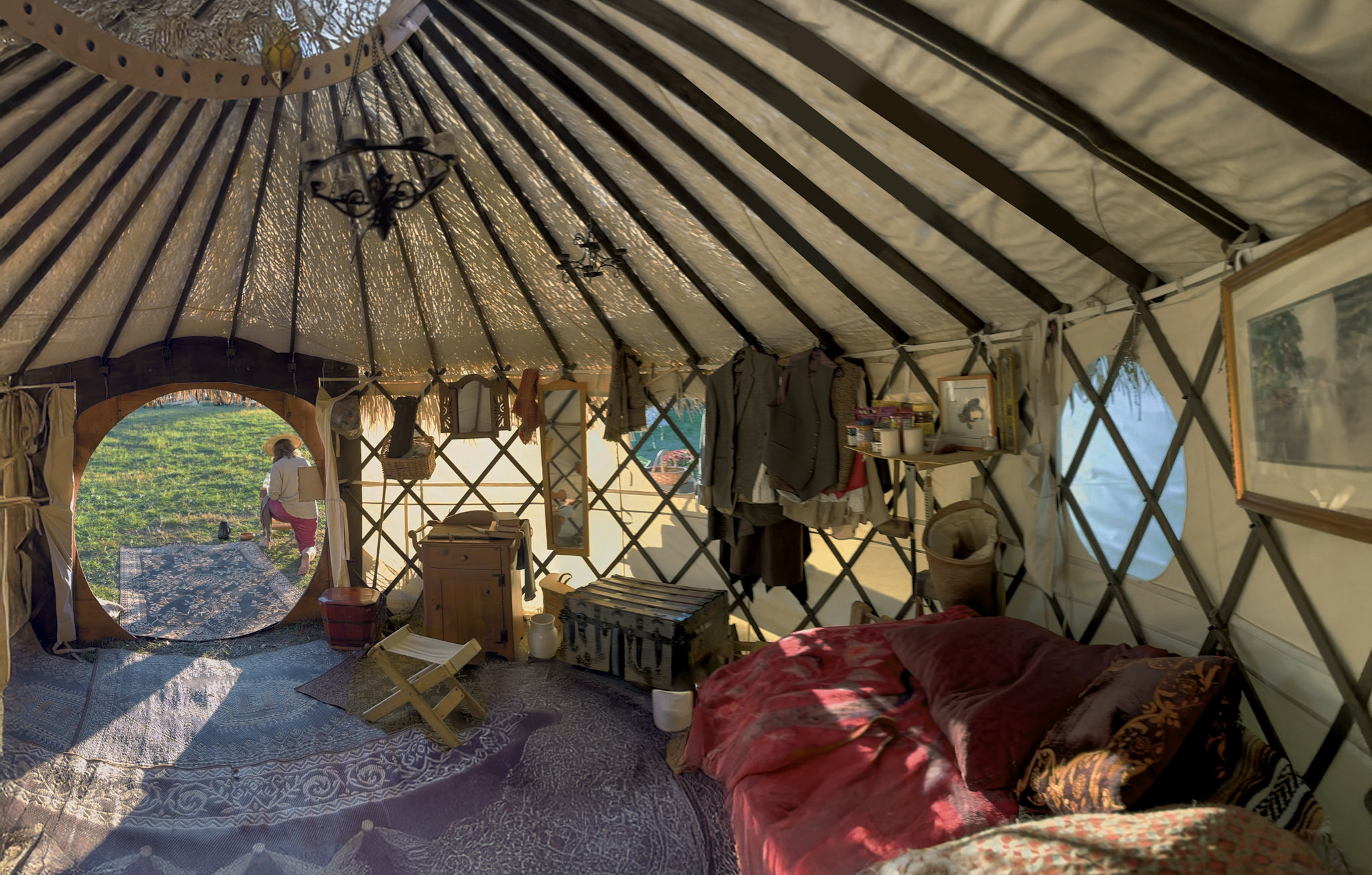
Do not underestimate how much you can hang from the walls and the roof. That is one of the huge differences between a tent and a yurt, and between a tent and a home. In your room at home, you have art hanging on the walls, a closet rod, a towel bar, a mirror. A home is a place where you can hang things from the structure, use the structure to support fixtures, a candle holder, a lantern, a hanging plant.
Don't think "I don't really have a place for this." Yes, you do. I promise you. You have a place for this. It gets everything off the ground, saves foot space, and opens up enormous creative possibilities for decorating. The yurt itself is the display.
What would your own burrow look like?
Definitely a long bed, a dining table, lots of artwork on the walls. I always think of those little pencil illustrations in the movies, grandmother and grandfather just sitting on the mantle. Very homey touches. And more plants, inside and out. My husband and I are both very much into gardening. I'd love to have lush plants inside and garden beds out front.
One small thing we are also doing: everyone who rents a burrow gets to name it. What will you call your burrow? The Tuckborough Estate? The Purple Plum Inn? I'm going to make a little wooden sign for whoever that is — two copies, so they can hang one on their door and one on their mailbox. And it goes home with them between years. My hope is that if I have repeat guests, someone can look up on a shelf twenty years later and have twenty of these lined up and go, "Ah yes, I remember that year."
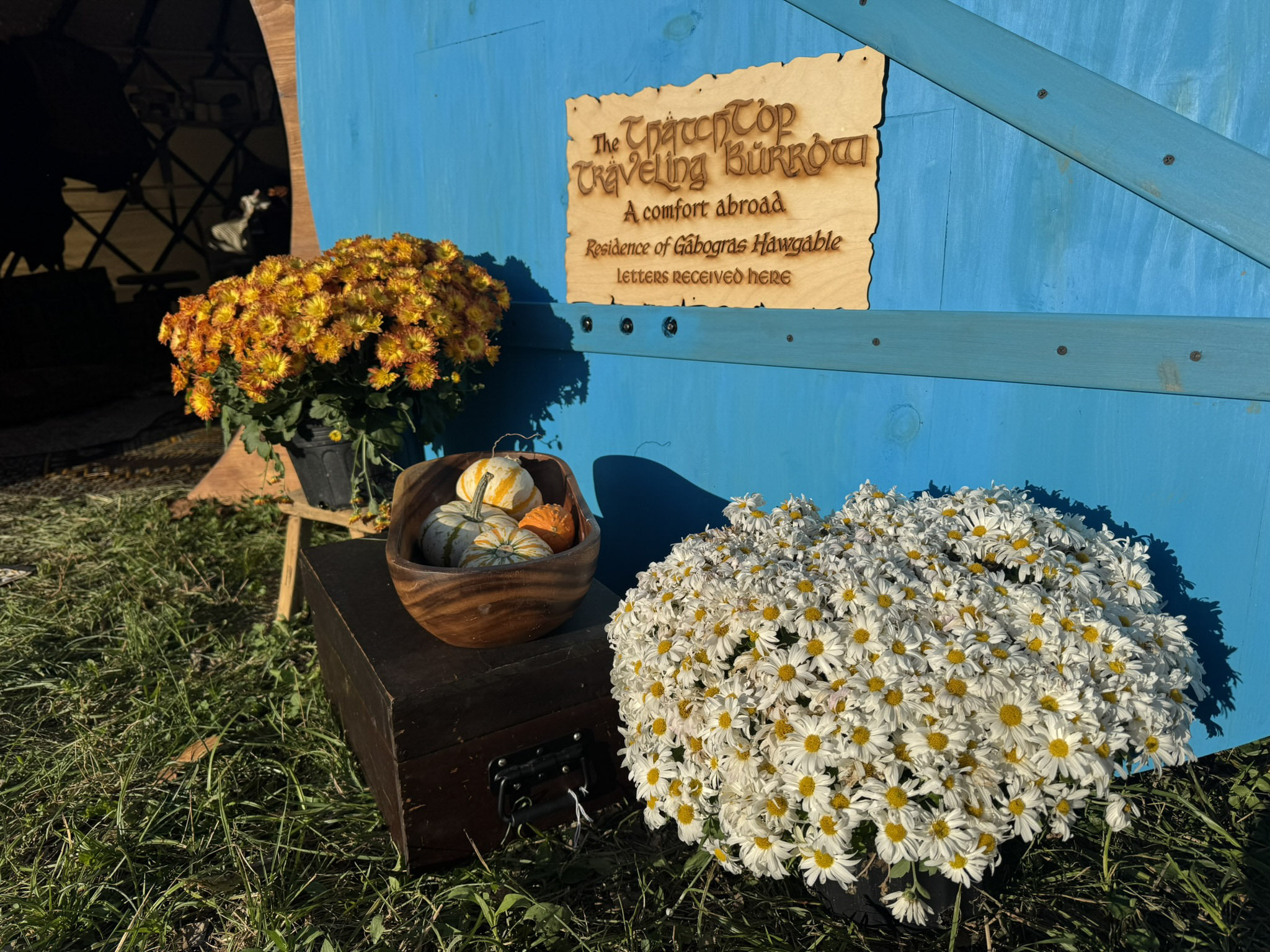
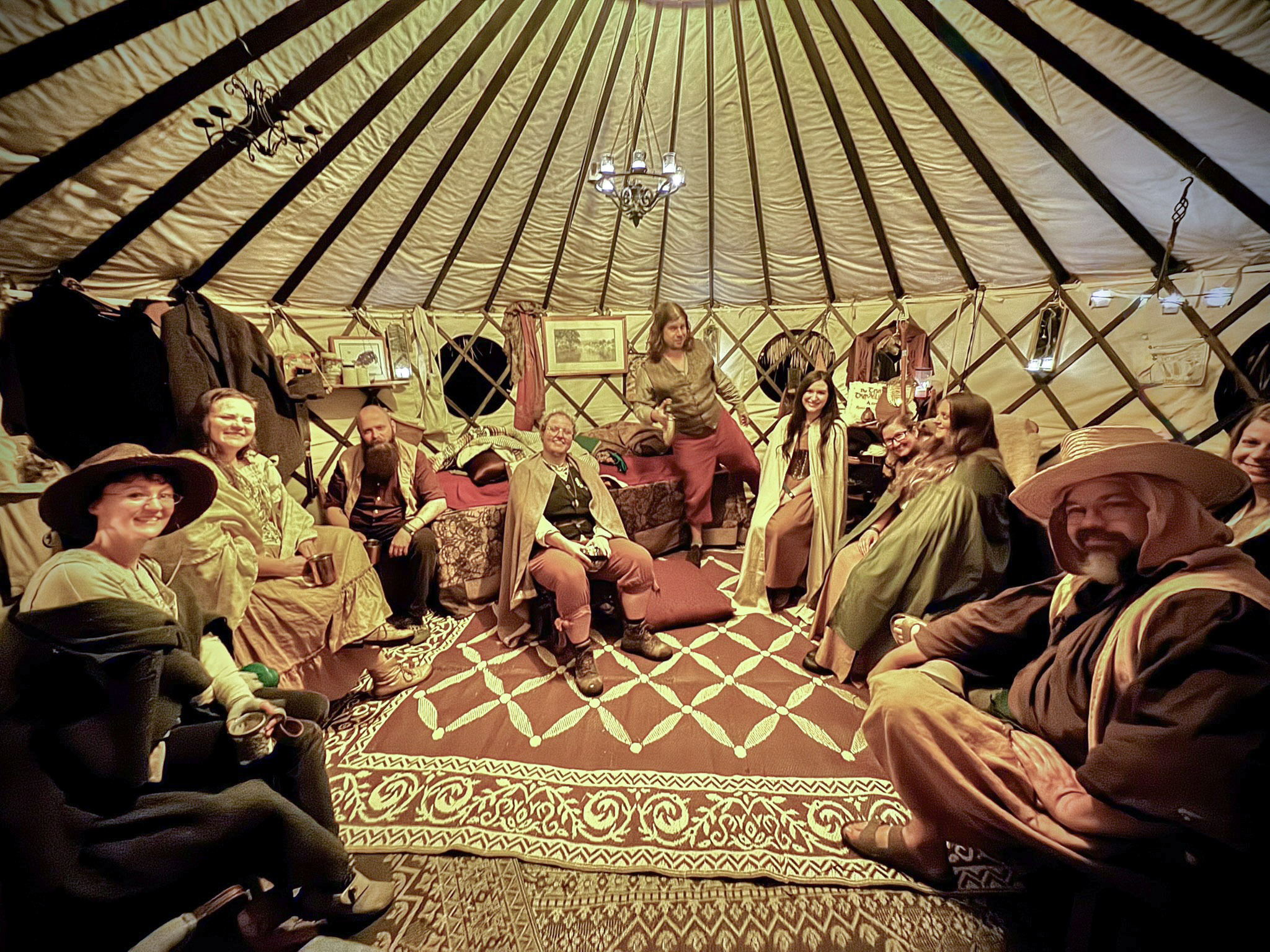
I really do hope the burrow will be a place where some people's core Brandywine memories are made. Door thrown open, people piling in, a cup of tea, a drink, some conversation. We had up to sixteen people sitting in the prototype one night at the first Brandywine Festival. It is just such a lovely space to host in. You have this portal literally into the world, and people have a portal into the coziness inside, and it just draws people in. That's the magic I'm hoping to build.